Capture
Digitising Reference Books: Decisions You Cannot Undo
Rescanning is expensive, slow, and frequently impossible — the volume goes back to a lender, the binding will not survive a second pass, or the person who knew the collection has moved on. Almost every regret in a digitisation project traces back to a decision made in the first afternoon.
This page is about those decisions. It assumes a small operation: a table, a camera or a flatbed, more volumes than time, and no conservation department to call. That describes most reference digitisation that actually happens.
Capture a master, publish a derivative
The single most valuable habit is separating the preservation master from the access copy. The master is captured once, at the highest fidelity you can sustain, and then never touched again. Everything the public sees — the compressed page image, the thumbnail, the OCR text — is generated from it and can be regenerated at will.
Projects that skip this step and publish their only copy get trapped. Better compression arrives and cannot be adopted. A viewer changes its required format. An OCR engine improves dramatically and there is nothing to re-run it against. The Library of Congress digital preservation programme publishes format sustainability assessments that are worth reading before committing to anything, and its recommended-format guidance is unusually candid about trade-offs.
For masters, uncompressed or losslessly compressed raster formats remain the safe answer. The temptation to store lossy files because storage costs money should be resisted for exactly as long as you can afford to resist it.
Resolution is set by the smallest thing that matters
The usual rule of thumb — a few hundred pixels per inch — is a poor guide for reference material, because reference material is where the smallest type in the whole collection lives. Dictionary abbreviations, gazetteer coordinates, footnote apparatus and index entries are routinely set several sizes below the body text.
Set resolution from the smallest glyph you need to survive, not from the page size. In practice, capture a test page containing the worst case, output at your candidate settings, and try to read it at 100%. If a human struggles, OCR will do worse. This one test, done properly on day one, prevents the most common form of rescan.
The physical rig
Three things matter more than the camera.
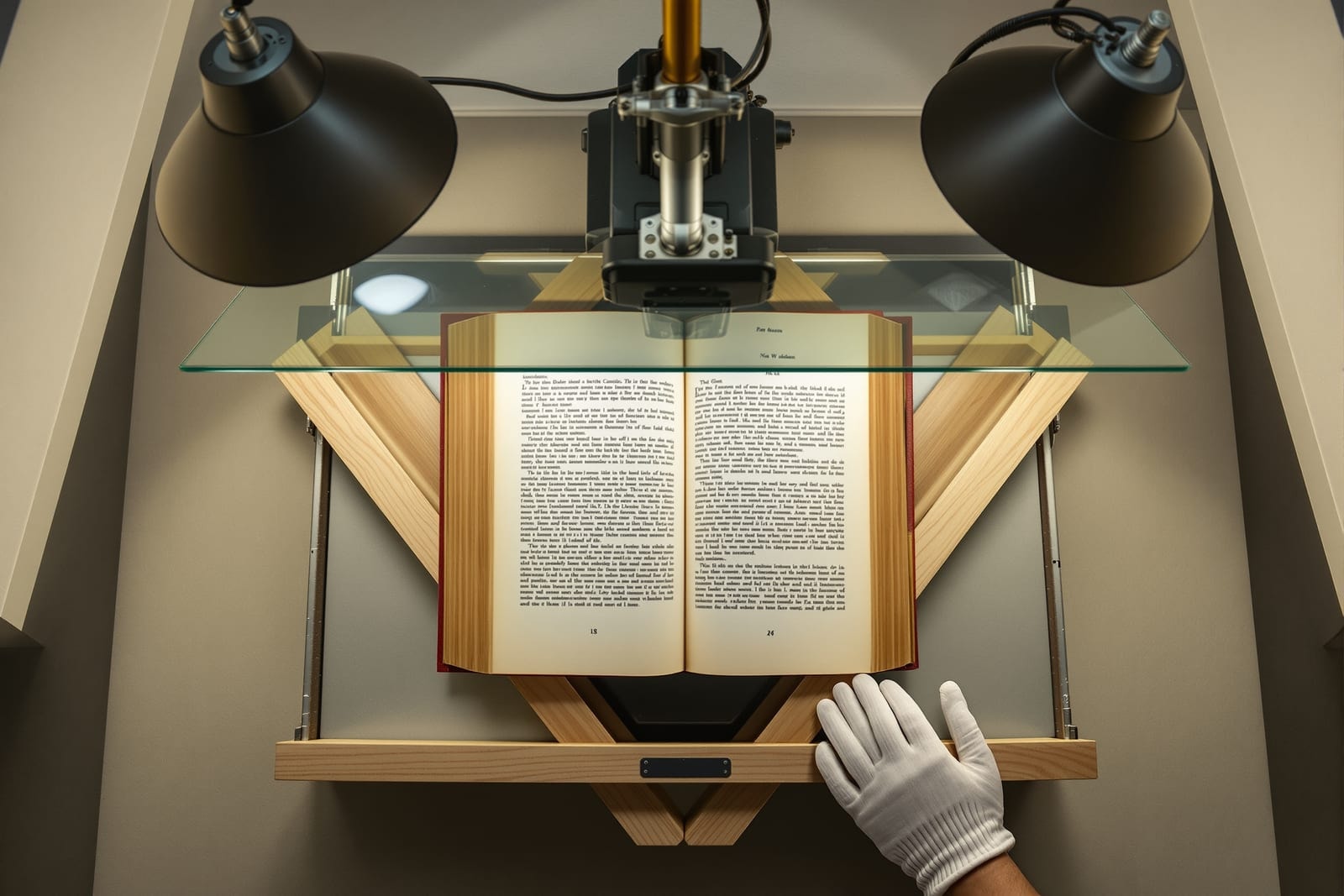
- The cradle. A tightly bound reference volume will not open flat, and forcing it damages the spine and curves the text into the gutter where recognition fails. A V-shaped cradle supports the boards at an angle the binding tolerates. Improvised cradles from foam wedges work.
- The light. Two diffused sources at a low angle from either side, balanced, with no window contributing. Raking light exaggerates paper texture and cockling; direct overhead light produces a hotspot in the middle of the page. Consistency between sessions matters more than absolute quality — a collection lit three different ways is a collection that cannot be processed uniformly.
- The target. A colour and greyscale target in the first frame of every session. It costs seconds and it is the only way to know later whether a colour shift is in the paper or in the lighting.
Page order and the structural map
Images alone are not a book. A digitised volume needs a structural record: which image is which page, where the front matter ends, which plates are unpaginated, where the volume breaks. Reference works make this harder than novels because they are full of inserted maps, fold-outs, tipped-in plates and unnumbered tables.
Record the mapping as you capture, not afterwards. Filenames carrying a strict sequence number, plus a simple manifest listing sequence, printed page number and page type, is enough. The International Image Interoperability Framework exists in large part to standardise exactly this relationship between a sequence of images and the structure of the object they represent, and adopting its vocabulary early is cheaper than retrofitting it.
Fold-outs, plates and the awkward cases
Every reference collection has items that break the workflow: a map bound in that is four times the page size, a plate too dark for the standard exposure, a table printed across a spread. The failure mode is silent — they get skipped, and nobody notices until a reader asks for the map.
Handle them by logging them rather than solving them immediately. A running exceptions list, captured during the main pass, converts an invisible gap into a small scheduled task. Projects that try to solve each awkward item as they meet it lose their rhythm and stall.
Provenance notes are part of the object
Write down the copy you scanned, its condition, the equipment, the settings and the date. If a page was missing or torn, record that too. When a user later asks why an entry is absent, the honest answer — the source copy lacked it — is only available if somebody wrote it down at the time. Preservation metadata standards such as PREMIS formalise this, but a plain text file per volume beats an unimplemented standard every time.
Next
Once pages are captured, the work moves to recognition and layout — see scanning and OCR. If the volume is a dictionary or encyclopaedia rather than continuous prose, read structuring an encyclopaedia before you start, because the capture decisions above interact with the data model you will eventually need.